Menu
Evidence hub
Explore the data, polling and facts that sit behind IFC Forum’s work.
Myths vs Reality
Are the CDOTs tax havens?
No. Low-tax jurisdictions are not the same as secrecy jurisdictions. Many CDOT structures are designed to be tax neutral, meaning they help international investment flow without creating extra layers of tax before profits reach the investor or the country where the real economic activity happens. That is about reducing double taxation and facilitating global capital flows. The idea that money can be hidden in the CDOTs is outdated. All CDOTs have implemented the OECD Common Reporting Standard, under which financial account information is automatically provided to HMRC and other tax authorities. This makes bank secrecy or tax evasion by moving offshore impossible.
Source: OECD
Do the CDOTs operate in secrecy?
No. All CDOTs have implemented the OECD Common Reporting Standard, so financial account information is automatically shared with HMRC and other tax authorities. Their beneficial ownership registers are also already accessible to the UK government through Exchange of Notes agreements, with no limit on use, and UK law enforcement has found this system “extremely useful”. All CDOTs also require beneficial ownership information to be verified and are also in the process of introducing access to parties with a legitimate interest in the information.
Source: UK Government
Do the CDOTs enable sanctions evasion?
No. UK sanctions apply fully in the CDOTs, with each jurisdiction operating its own sanctions authority in coordination with OFSI. The UK government says the Crown Dependencies and Overseas Territories play a “vital role” in implementing and enforcing sanctions, and OFSI has said they have played a “critical role” in the Russia sanctions regime by freezing significant assets. The OTs have frozen over £7 billion in Russia-linked assets since 2022, more than Switzerland and the USA.
Source: UK Government
Do the CDOTs only benefit financial centres around the world?
No. Investment channelled through the CDOTs supports a wide range of economic activity in onshore economies, not only major financial centres. Funds domiciled in these jurisdictions invest in infrastructure, real estate, private equity and other productive assets, helping to finance projects, support jobs and connect capital with opportunities in different regions. For example, private equity, property and infrastructure account for over 80% of Guernsey funds’ investment into the UK.
Source: Frontier Economics
Are the CDOTs irrelevant to onshore economic growth?
No. The CDOTs play a practical role in global growth by helping capital move between investors, businesses and markets. Their international financial centres support cross-border investment, trade and risk management, providing the legal, financial and professional services needed to structure and deliver international transactions. For example, in 2024 the CDOTs channelled £332bn of investment into the UK, equal to 15.6% of total inward FDI, and accounted for 1.9% of total UK trade.
Source: UK Government
Do the CDOTs support jobs and industry outside their jurisdictions?
Yes. The CDOTs support major onshore sectors including investment funds, insurance, legal services, infrastructure and international finance. By helping businesses raise capital, manage risk and invest across borders, they support jobs and economic activity in the markets where that capital is deployed. For example, BVI corporations facilitate an estimated US$1.4 trillion in cross-border trade and investment, with investment mediated through the BVI supporting around 2.3 million jobs globally and generating an extra US$14bn a year in tax revenues for governments worldwide. In the UK alone, BVI-mediated investment supports 134,000 jobs and generates US$3.5bn in tax revenues.
Source: Pragmatix Advisory
Are the CDOTs only an economic asset, or do they matter strategically too?
They matter strategically as well as economically. The CDOTs are self-governing jurisdictions with important regional, legal and geopolitical roles. Their stability, legal systems and international links support trusted cross-border business, while several also contribute to defence, security and global connectivity. For the UK, this includes critical support to the Armed Forces through military bases, training facilities and logistics hubs, including Gibraltar’s naval base and the Falklands’ air defence role.
Source: House of Lords Constitution Committee

Data & polling

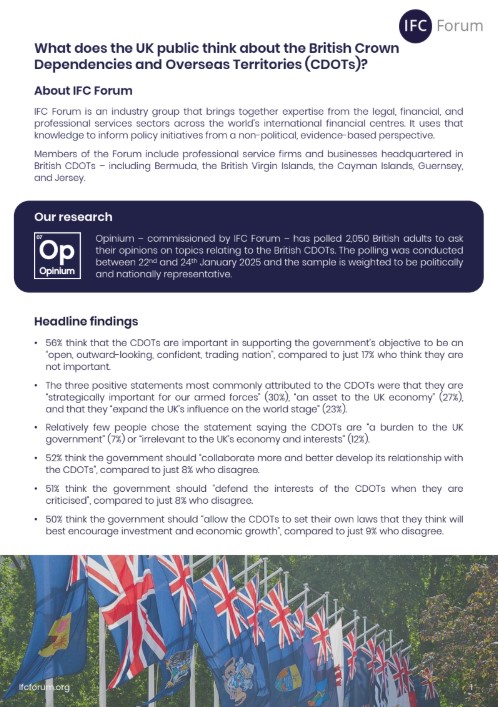
Our evidence base includes public polling, economic data and practical examples from across the Crown Dependencies and Overseas Territories.
56%

of the British public think the CDOTs are important in supporting the UK’s ambition to be an open, outward-looking, confident, trading nation.

51%

of the British public think the British Government should defend the interests of the CDOTs when they are criticised. Only 8% oppose and 18% don’t know, 23% neither support nor oppose.

50%

of the British public think the British Government should allow the CDOTs to set their own laws that they think will best encourage investment and economic growth. Only 9% oppose and 19% don’t know, 22% neither support nor oppose.

Economic contribution to the UK

2nd

largest source of FDI into UK
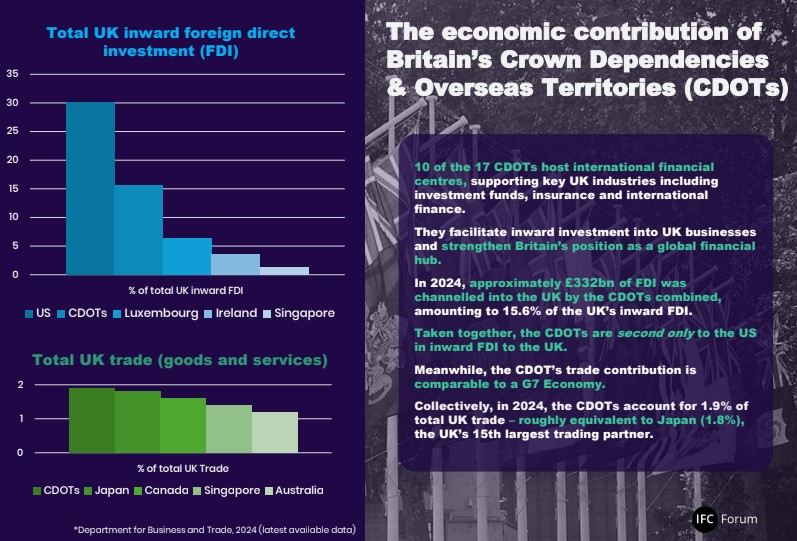
Total UK inward foreign direct investment (FDI)

The CDOTs facilitate £332bn of foreign direct investment (FDI into the UK, amounting to 15.6% of the UK’s inward FDI. Taken together, the CDOTs are second only to the US as a source of inward investment to the UK.

15th

largest UK trading partner
Total UK trade (goods & services)

Trade with the CDOTs also equates to 1.9% of total UK trade, making the CDOTs the 15th largest trading partner and roughly equivalent to Japan as a trading partner (which accounts for 1.8% of UK trade).

3.5%

of total UK services trade

Their importance is even clearer in services trade. Combined UK services trade with the CDOTs was £29.2bn in 2024 – 3.5% of total UK services trade.

Economic contribution to the EU
The CDOTs’ financial centres contribute hugely to the EU’s economy
British Virgin Islands
~460 k
EU jobs
British Virgin Islands ‘Business Companies’ support approx. 2.3 million jobs globally, with about one-fifth of these in Europe
(BVI Finance)
Bermuda
$ 29.3 bn
to EU policyholders
Bermuda-based (re)insurers paid out $29.3 billion to EU policyholders for property and casualty losses and life insurance claims during the five-year period from 2016 to 2020
(Association of Bermuda Insurers and Reinsurers)
Jersey
25 %
assets to EU
25% of the assets held, administered or managed in Jersey are invested into the EU
(Jersey Finance)
Gibraltar
€ 48.1 bn
FDI to EU
Gibraltar channels €48.1bn billion of Foreign Direct Investment into the EU (2024), the single largest source of inward investment
(European Commission)
Research on individual CDOTs
Jersey
financial services represent 40% of GDP Go to overview
Cayman Islands
financial services represent 30% of GDP Go to overview
British Virgin Islands
International business employs over 5,000 people, about 15% of all jobs Go to overview
Isle of Man
financial services support around 10,000 jobs and contributes around £2.7bn to GDP Go to overview
Guernsey
financial services represent 37% of GDP Go to overview

Reports & publications

Read and download reports, briefings and other publications about the Crown Dependencies and Overseas Territories.
Polling Summary
Commissioned by IFC Forum in 2025, Opinium polled 2,050 British adults to ask their opinions on topics relating to the British CDOTs.
Go to overview
Economic Contribution Briefing
This briefing collates insights from the Department for Business and Trade (2024) on the significance of CDOTs and Overseas Territories for UK trade and inward investment.
Go to overview

The information provided on the IFC Forum website (https://www.ifcforum.org/) is for general informational and educational purposes only.
The content on this website does not constitute, and should not be construed as, legal, financial, tax, investment, or other professional advice. Readers should consult with qualified professional advisors before acting on any information contained herein.


No Liability
While we endeavour to ensure that the information on this website is accurate and up to date, IFC Forum makes no representations or warranties of any kind, express or implied, about its completeness, accuracy, or reliability. Any reliance you place on such information is strictly at your own risk. IFC Forum, its member firms, and its affiliates will not be liable for any loss or damage arising from the use of this website.